
可凡倾听
多部门开展燃气安全联合检查_我的网站

A |
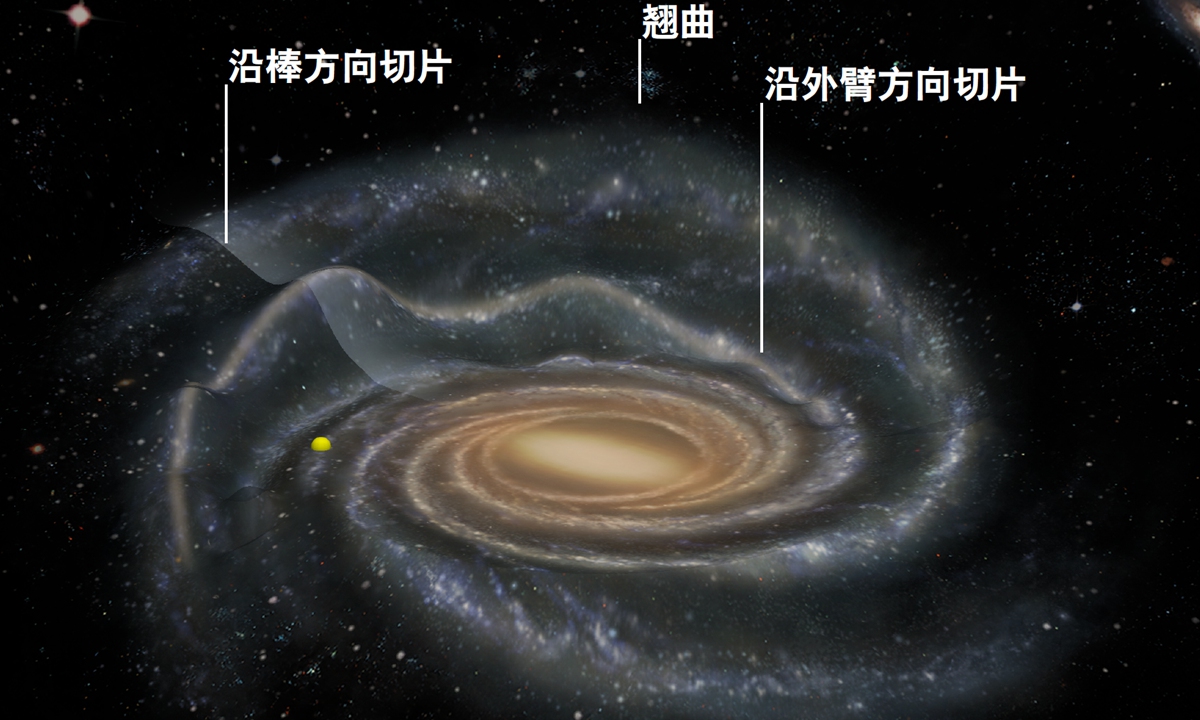
Chinese astronomers have discovered that the Milky Way is not a simple, smoothly warped disk, but contains widespread "wrinkle-like" structures resembling ripples on a water surface, providing new clues to understanding the galaxy's 3D structure and evolutionary history.
The discovery was made by a research team from the Purple Mountain Observatory (PMO) under the Chinese Academy of Sciences, using data from the "Milky Way Imaging Scroll Painting" (MWISP) survey. The findings were published online titled "Widespread corrugations superimposed on the Galactic warp in the outer CO disk" in the journal Nature Astronomy on August 7.
For decades, astronomers have known that the Milky Way's disk is not perfectly flat. Instead, its outer regions are slightly bent upward on one side and downward on the other - a structure known as a galactic warp.
However, the latest study shows that this large-scale bending is not the whole story. Smaller-scale vertical fluctuations are also embedded within the warped disk, creating a more complicated 3D structure.
"In many illustrations and in the public imagination, the Milky Way looks like a flat vinyl record," Sun Yan, associate researcher at PMO and the first author of the paper, told the Global Times on Tuesday. "In reality, the outer part of the Milky Way is more like a record that has been heated and deformed, with one side lifted and the other side lowered. That is the warp. On top of this large-scale deformation, there are additional smaller waves, which we call corrugations," Sun explained.
Using a more everyday analogy, Sun compared the Milky Way's structure to a sea surface. The warp is like a large swell that changes the overall height of the ocean, while corrugations are smaller waves superimposed on that swell.
"The two structures exist together. In our data analysis, we first removed the large-scale warp model, which allowed us to reveal the smaller wave-like patterns hidden underneath," Sun said.
The research focused on the Milky Way's outer gas disk rather than the more familiar stellar disk. According to Sun, cold molecular gas and stars provide two complementary ways to study the galaxy.
"Molecular gas is a sensitive probe for studying the vertical structure and dynamics of the galactic disk because it is concentrated near the disk plane and responds strongly to disturbances," she said.
Molecular gas is also the raw material for star formation, meaning its distribution is closely connected with the formation of young stars. The researchers traced this gas through carbon monoxide (CO) emission, which can penetrate regions obscured by interstellar dust and provide a different perspective from optical observations of stars.
The breakthrough was made possible by the MWISP survey, conducted using China's 13.7-meter millimeter-wave telescope.
"MWISP can be understood as giving the Milky Way a large-scale medical examination using millimeter-wave observations," Sun said.
Previous CO surveys were limited in sensitivity and coverage, making it difficult to accurately study the distant outer regions of the galaxy. In contrast, the latest study identified more than 30,000 molecular cloud samples, covering about half of the Milky Way's outer disk and extending to a distance of about 26 kiloparsecs from the Galactic center.
With such a large dataset, researchers were able to first establish a model of the overall warp and then separate subtle structures from the background. The newly identified corrugations have radial wavelengths of about 3.9-7.9 kiloparsecs and vertical amplitudes of about 100-200 parsecs.
The study also identified a corrugation structure extending about 40 kiloparsecs in azimuth at a distance of around 12.7 kiloparsecs from the Galactic center. In some spiral arm regions, vertical displacements can reach approximately 200 parsecs.
The researchers believe these large-scale vertical fluctuations are likely related to "bending waves" triggered by external gravitational disturbances, suggesting that the Milky Way might have experienced more complex interactions during its evolutionary history.
Although the newly discovered structures sound dramatic, they do not have any direct impact on Earth or the solar system. "Humans cannot directly sense these corrugations," Sun said. "Their scales reach thousands or even tens of thousands of light-years, and even if these structures are evolving, such changes would not be directly perceptible on human timescales."
The study focuses on the outer disk of the Milky Way and does not include the region around the solar system. "There is currently no evidence that these structures have any observable influence on Earth's environment," Sun said.
Instead, their significance lies in what they reveal about the past. Like geological layers recording Earth's history, these galactic structures preserve traces of the Milky Way's evolutionary journey, the researchers explained.
Researchers said future studies combining more precise motion measurements and numerical simulations could further reveal the origins of these structures and their role in the long-term evolution of the Milky Way.
。 本网讯 特约记者刘雨晴报道 7月11日,兴城市住建局燃气办组织燃气专班相关单位对海边餐饮业进行燃气安全联合检查,保障旅游季节兴城市燃气安全稳定。 检查中,工作人员对餐饮场所内燃气用具的使用是否符合安全要求,是否安装燃气安全装置,是否存在无标识、过期或者报废的液化气钢瓶,液化气与灶台相连的管线是否存在老化等事项进行细致检查,并对发现的安全隐患现场指导其进行整改,不能现场整改的下发责令限期整改指令书,督促燃气用户及时整改。同时,工作人员还对餐饮业进行燃气安全知识宣传,为燃气用户作全面的安全用气指导。

B |
Current article:http://rvl.niaozaogunbaizhaiguaweng.bond/vabpgoq/20260826/681011.html
Published on:00:00:00